



BRISTOL VIDEO CO.

A beautifully shot corporate film can be let down by one thing: poor sound. Professional sound recording for video is just as important as cinematography, lighting and editing.
You might have carefully composed interviews, attractive lighting and excellent production design, but if the dialogue is muffled, the room is echoing or background noise is fighting the speaker, the finished video immediately feels less professional.
Sound is one of the most important and frequently underestimated elements of video production. For brand films, corporate promotional videos and commercial content, good audio does more than make speech understandable. It establishes atmosphere, creates depth and gives the entire production a sense of quality.
At Bristol Video Co., we consider sound recording an essential part of the production process, whether we’re filming a corporate interview in Bristol, recording a voiceover in a studio or capturing content on location across the South of England.
The technical decisions behind that sound, from microphone selection and positioning to recording formats and acoustic control, can make a substantial difference to the final film.
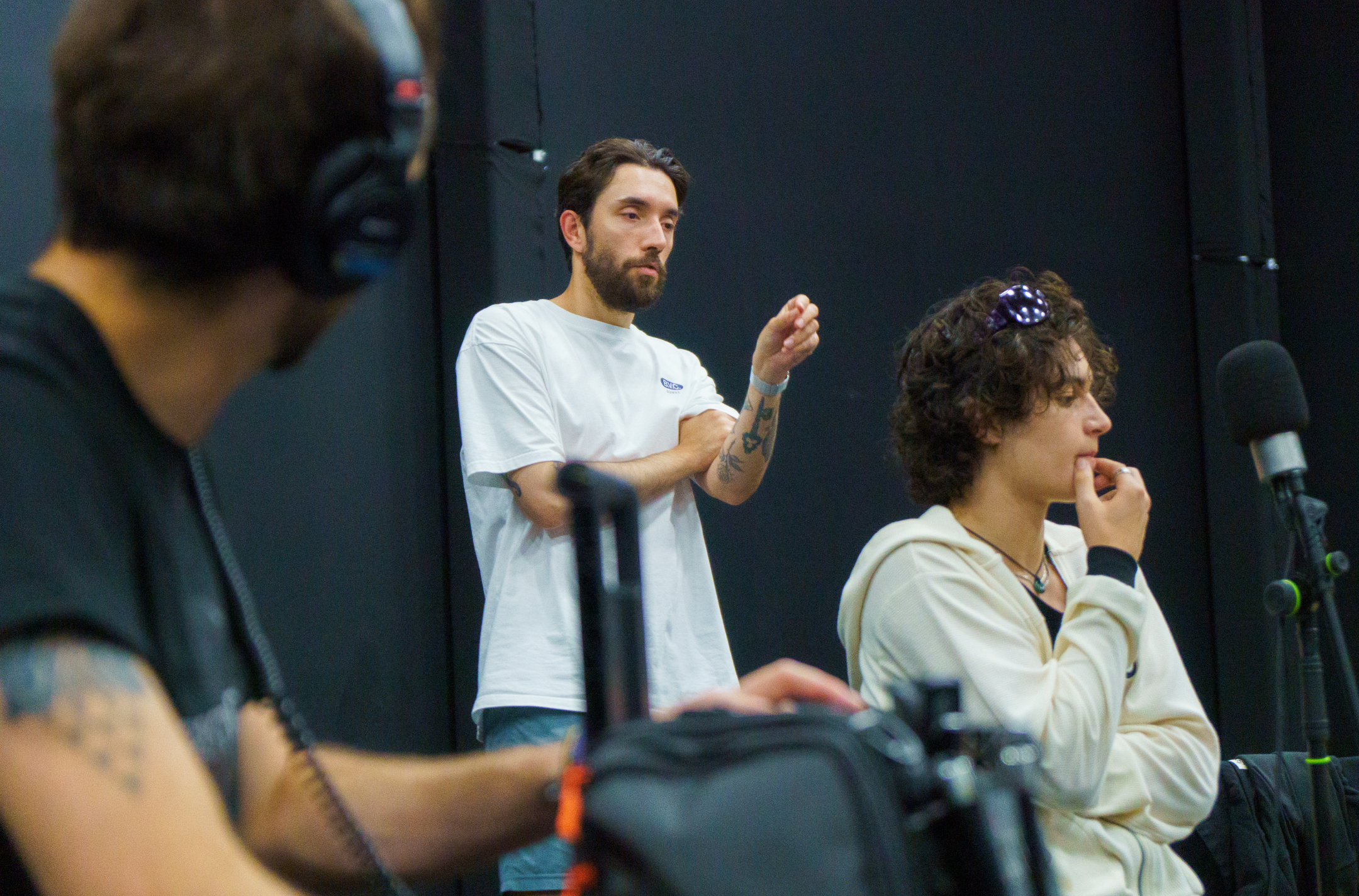
Behind the Sound: Recording for CTZEN
Bristol Video Co. director Denis Hoti works with CTZEN founder Seth Renaud during a voiceover session, with sound recordist Mark Oshana monitoring the recording.
Why Professional Sound Recording Matters for Corporate Video
The relationship between sound and perceived production quality is particularly important in corporate filmmaking.
Consider a company director explaining a complex service on camera. The image is sharp, the lighting is balanced and the composition looks professional. But the recording has noticeable reverberation from the surrounding office, a low-frequency air-conditioning hum and occasional bursts of distortion.
Even if the viewer understands every word, the result is distracting. Their attention moves away from the message and towards the imperfections in the recording.
Now consider the same footage with close, natural-sounding dialogue, controlled background ambience and a carefully balanced soundtrack. The speaker feels present, credible and easier to engage with.
This is especially important for customer testimonials, executive interviews, product demonstrations and company films, where much of the video’s effectiveness depends on people communicating clearly.
Poor audio can also become an expensive production problem. A badly exposed image may be recoverable in colour grading, but severe microphone distortion, overlapping speech or heavy reverberation can be far harder to repair convincingly.
Sound Recording for Video Starts Before Filming
One of the most effective ways to improve sound quality is to make the right decisions before the cameras are set up.
A common challenge in corporate video production is the filming environment itself. Modern offices are often designed around glass partitions, polished floors, exposed concrete and large open spaces. Visually, these locations can look excellent. Acoustically, they can be difficult.
Hard surfaces reflect sound waves, creating reverberation and early reflections that reach the microphone shortly after the speaker’s direct voice. The result can sound hollow, distant or excessively bright.
An expensive microphone will not automatically solve this problem.
The key is improving the ratio between the direct speech and the reflected sound. Moving the microphone closer to the speaker generally increases the amount of direct voice captured relative to the surrounding room.
Where possible, we also consider the choice of room, furniture, soft furnishings and temporary acoustic treatment. Thick curtains, rugs and strategically positioned absorptive panels can reduce reflections, although they do not necessarily stop sound entering from outside.
This distinction between acoustic treatment and sound isolation matters. Acoustic treatment controls how sound behaves within a room, while isolation reduces sound transmission between spaces.
A meeting room with soft furnishings may produce a better interview recording than a large, impressive-looking boardroom surrounded by glass.
Location Sound Recording for Video: Boom or Lavalier Microphones?
Choosing the right microphone is central to professional location sound recording.
For corporate interviews and branded content, two common options are boom-mounted directional microphones and lavalier microphones. Both have advantages, and the best choice depends on the framing, environment and movement of the contributor.
Boom microphones
A boom microphone is positioned close to the speaker, usually above and slightly in front of them, just outside the camera frame.
Directional microphones, including shotgun and supercardioid designs, are useful for concentrating on the speaker while reducing sound arriving from less favourable directions.
However, shotgun microphones are not universally the best choice indoors. Longer interference-tube designs can produce unwanted tonal coloration when used in highly reflective rooms. A well-positioned supercardioid microphone without a long interference tube may give a more natural result in those conditions.
The important variable is not simply how directional the microphone is. It’s how well its pickup characteristics suit the room and the speaker’s position.
Lavalier microphones
Lavalier microphones, often called lapel microphones, are small microphones attached to a contributor’s clothing.
Their main advantage is consistency. Because the microphone moves with the contributor, the distance between the microphone and their mouth remains relatively stable.
This makes lavaliers useful for interviews, walk-and-talk sequences, demonstrations and situations where a boom cannot remain close enough without entering the shot.
Their main weakness is clothing noise. Fabric brushing against a hidden microphone can introduce clicks, scratches and rustling that are difficult to remove without affecting the dialogue.
Careful mounting, cable management and listening tests are essential. Wireless systems also require attention to radio-frequency interference, battery levels and signal dropouts.
On suitable productions, recording both a boom microphone and a lavalier on separate channels provides useful flexibility and redundancy. It allows the sound editor to select whichever recording offers the clearest, most natural dialogue.
Controlling Sound in Professional Filming Environments
Sound recording for video becomes more complicated when filming outside a controlled studio.
An office in central Bristol might have traffic noise outside, a ventilation system running overhead and staff moving through adjoining rooms. A working factory may introduce machinery, mechanical vibration and unpredictable changes in background volume.
These sounds need to be identified before filming starts.
An experienced sound recordist listens for things the camera operator may not notice. That includes electrical hum, air-conditioning noise, reflections, passing vehicles, clothing movement and interference from nearby wireless equipment.
Closed-back monitoring headphones are essential. Watching audio meters alone is not enough: meters can show a healthy signal while the recording contains unwanted noise.
Another useful technique is recording room tone, typically around 30 seconds of uninterrupted ambience from each filming location.
Room tone provides the editor with a consistent background layer that can help smooth dialogue edits and remove unnatural moments of complete silence between takes.
On location, it’s also worth recording individual environmental sounds. Machinery starting, footsteps, doors closing or the natural ambience of a workspace can all become useful material for sound design later.
Studio Voiceover Recording: Precision and Consistency
A professional recording studio gives considerably more control over the sound environment.
For corporate explainers, product films, advertising campaigns and brand content, a studio voiceover can provide consistency that is difficult to achieve on location.
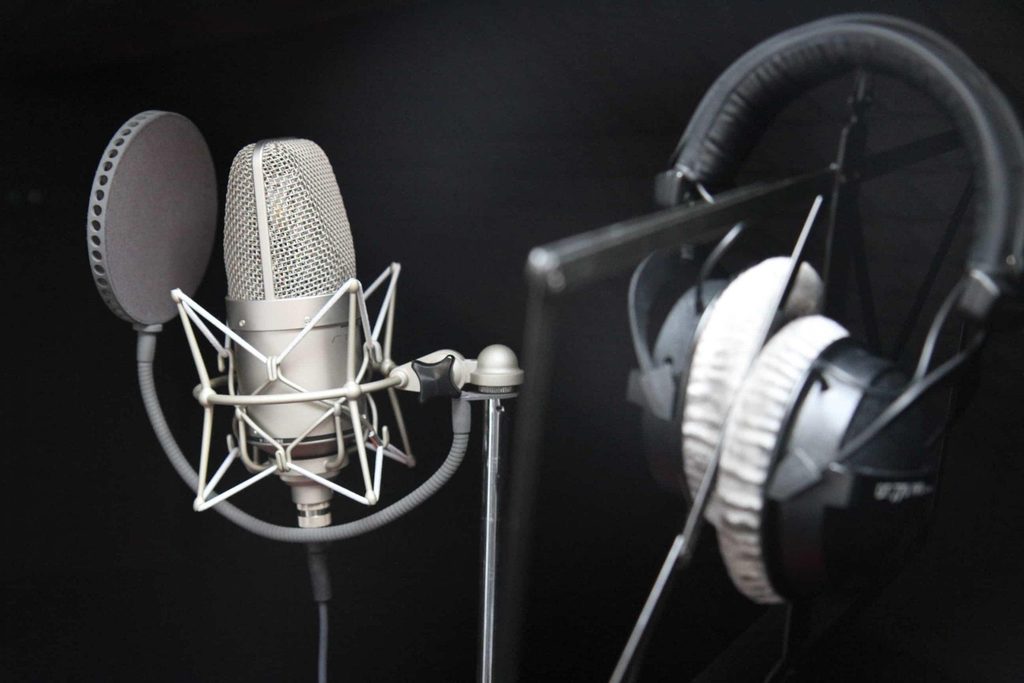
A typical voiceover recording chain might involve a large-diaphragm condenser microphone, a pop filter, a quality microphone preamplifier and a dedicated audio interface or recorder.
Condenser microphones are often selected for their sensitivity and detailed reproduction, although the microphone should always suit the voice and recording environment.
A pop filter reduces plosive bursts caused by consonants such as ‘p’ and ‘b’. Maintaining a consistent microphone distance, often around 15 to 30 centimetres depending on the microphone and voice, helps minimise changes in level and tonal balance.
The recording space matters just as much as the equipment. A properly treated room reduces unwanted reflections, allowing the voice to sound direct and controlled without requiring excessive processing afterwards.
Professional voiceover recording is also about performance. Microphone technique, pacing, breathing and articulation have a significant effect on the result.
For branded content, we pay particular attention to matching the voiceover to the visual direction. A technical product demonstration may require a measured, authoritative delivery, while a lifestyle or fashion campaign may benefit from something more conversational and understated.
The best voiceovers rarely sound forced. They should feel appropriate to the film and the audience.
The Technical Standards Behind Professional Audio
Audio recording specifications can seem less exciting than cameras and lenses, but they have a direct impact on post-production flexibility.
For most professional video productions, recording uncompressed WAV audio at 48 kHz and 24-bit is a practical industry-standard approach.
The 48 kHz sample rate is widely used for film and video workflows, while 24-bit recording provides substantial dynamic range and room for safe gain staging.
Some professional field recorders also offer 32-bit floating-point recording. When supported by the recorder’s complete signal chain, this provides enormous digital headroom and can preserve unexpected level peaks that would clip in conventional fixed-point recording.
However, 32-bit float does not solve every problem. It cannot repair a microphone capsule that has been physically overloaded, remove intrusive room noise or restore dialogue obscured by another sound.
A clean signal at the microphone remains the priority.
For conventional 24-bit recording, we leave sufficient headroom for louder words, laughter and unexpected changes in delivery rather than pushing the signal close to digital clipping.
On multi-camera productions, accurate audio synchronisation also matters. Timecode, properly managed recording metadata and reference audio can help maintain sync between separately recorded sound and camera footage.
These are not details that should become visible to the client. They are part of a reliable production workflow that allows the editing process to run smoothly.
Sound Recording for Video Doesn’t End on Set
Capturing clean audio is the foundation, but professional sound post-production is where the various elements become a coherent soundtrack.
Dialogue editing usually begins by selecting the strongest recordings, removing unwanted noises and balancing differences between contributors.
Equalisation can reduce low-frequency rumble or unwanted resonances while improving speech clarity. High-pass filtering is often useful for removing energy below the useful vocal range, although the filter frequency needs to suit the voice and recording.
Compression can control differences between quieter and louder passages, making dialogue easier to follow without flattening the speaker’s natural dynamics.
De-essing may also be applied to reduce excessive sibilance, particularly on close-miked voiceovers.
Noise-reduction software, including tools such as iZotope RX, can help reduce background hiss, hum and certain isolated noises. Modern dialogue-isolation tools can be remarkably effective, but aggressive processing can introduce artificial-sounding artefacts and remove parts of the voice itself.
This is why we prefer to capture the cleanest possible recording rather than relying on software to rescue it.
Music, effects and dialogue need to work together
In a finished corporate promo, dialogue rarely exists in isolation.
Music establishes pace and emotion. Sound effects help transitions feel deliberate. Environmental sound gives locations texture and realism.
The challenge is creating a balance between these layers.
Music that sounds impressive on its own can easily mask speech when combined with a voiceover. Careful level automation and, where appropriate, frequency-conscious mixing help the dialogue remain intelligible without removing the impact of the soundtrack.
Final loudness also needs attention. Integrated loudness is commonly measured in LUFS, with true-peak measurement used to identify peaks that may cause playback issues.
For broadcast delivery, standards such as EBU R128 provide defined technical requirements. Online platforms have different playback and loudness-normalisation behaviours, so there is no single correct LUFS target for every corporate video.
A professional mix should be checked against the intended delivery requirements, then reviewed through headphones, studio speakers and typical consumer devices.
A promotional video needs to sound convincing on a laptop or smartphone, not only in an editing suite.
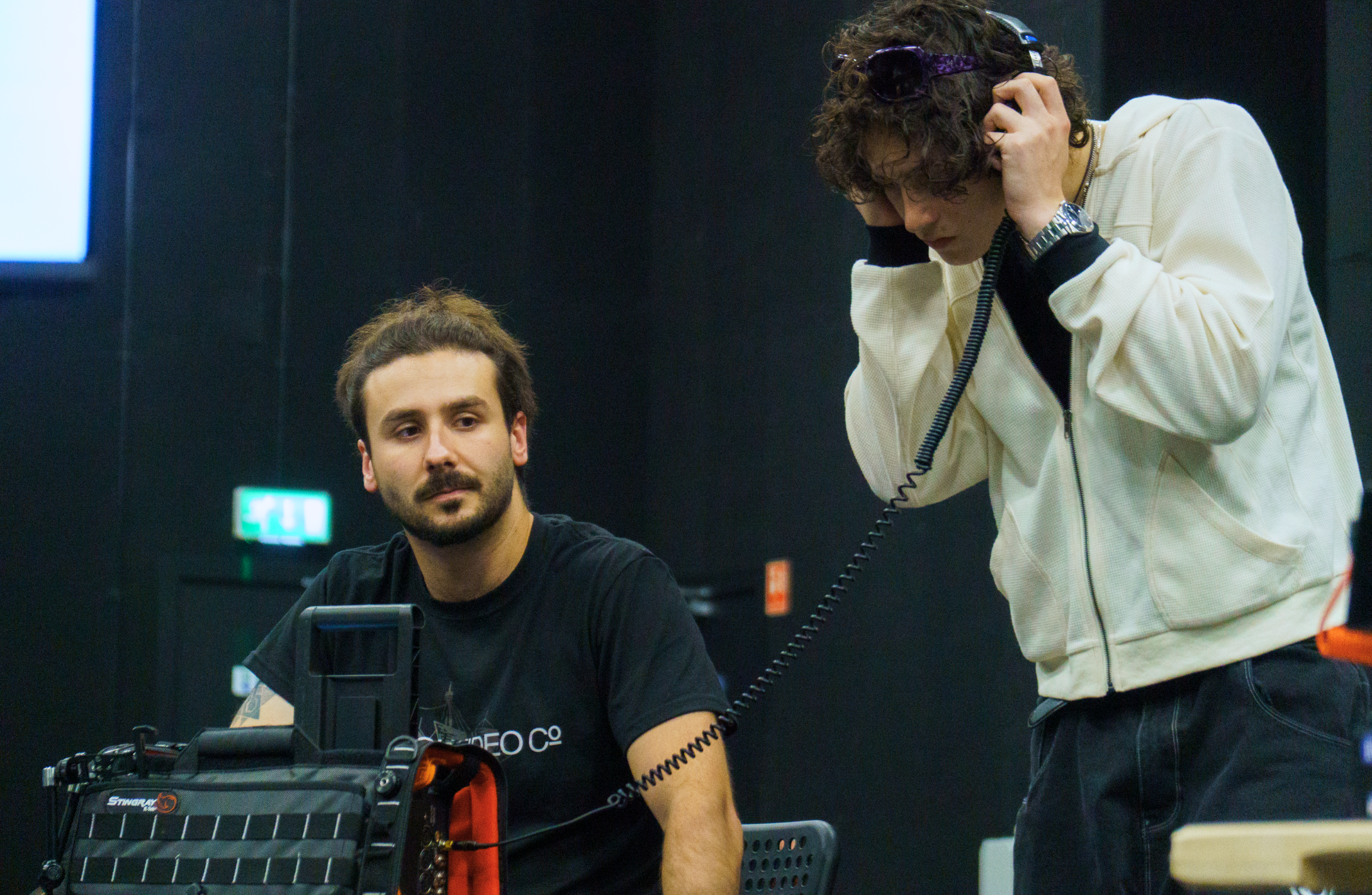
Behind the Sound: Recording for CTZEN
CTZEN founder Seth Renaud with Bristol Video Co. sound recordist Mark Oshana, reviewing audio playback during the brand campaign.
Sound Design Is Part of Brand Identity
Good sound is not limited to dialogue quality. It can also help a brand develop a recognisable character.
Consider a short product film. The sound of a mechanical switch, a carefully recorded surface texture or a subtle transition effect can give the visuals a sense of physical presence.
For a manufacturing company, the real sounds of machinery and production processes may be central to the story. For a design-led consumer brand, a restrained soundtrack with precise effects might communicate sophistication more effectively than dramatic music.
The aim is not to fill every moment with sound.
It’s to make deliberate choices about what the audience hears, what should remain subtle and when silence is more effective.
Overdesigned sound effects can make corporate content feel unnecessarily theatrical. Equally, a film with nothing beyond dialogue and a generic music track may miss opportunities to create atmosphere.
The best approach depends on the brand, its audience and what the film needs to communicate.
Can AI Fix Poor Audio Recording?
AI-assisted audio restoration has improved significantly, particularly for reducing background noise and isolating speech.
These tools can be genuinely useful when a recording contains unwanted ambience or when reshooting is impossible.
However, they have limitations.
A voice obscured by another speaker, affected by heavy reverberation or captured with severe microphone distortion may not contain enough usable information to restore naturally.
Some tools can reconstruct or estimate missing elements of the signal, but that is not the same as recovering the original recording.
For a short social media clip, a slightly processed result may be acceptable. For a major brand campaign or executive interview, unnatural dialogue can undermine the quality of the entire production.
AI is a useful addition to the sound editor’s toolkit. It is not a replacement for competent sound recording on set.
Professional Sound Recording for Video in Bristol and the South of England
At Bristol Video Co., audio is considered alongside cinematography, lighting and creative direction from the planning stages of a project.
Our production experience covers corporate films, brand content, events, interviews and promotional video. Projects such as our work for Bath Rugby and the Society of Operations Engineers’ IRTE Skills Challenge have involved dedicated sound-recording roles as part of the production team.
The requirements change from project to project. A controlled studio voiceover calls for a different approach from an interview in a working industrial environment or a multi-camera conference recording.
For businesses in Bristol, Bath, Somerset, Gloucestershire and across the South of England, the priority should be the same: recording sound that supports the message and gives the finished video the production quality it deserves.
Good audio is not simply about expensive microphones or sophisticated software. It’s about preparation, the right equipment, careful positioning, active monitoring and understanding how the recording will be used in the final edit.
A strong corporate video needs to look professional, but it also needs to sound right.
If you’re planning a brand film, corporate interview, promotional campaign or studio-based production, Bristol Video Co.’s corporate video production team can help plan the filming and audio requirements from the outset.
Get in touch with Bristol Video Co. to discuss your next project.
Further Reading: 12 Professional Sound Recording Resources
- RØDE: How to Record Better Interview Audio – Practical microphone selection and positioning for filmed interviews.
- Shure: Critical Distance and Microphone Placement – The relationship between microphone distance, reverberation and speech quality.
- Shure: How to Choose the Best Lavalier Microphone – Lavalier microphone selection and placement for spoken-word recordings.
- Wex Photo Video: Concealing Lavalier Microphones – Practical methods for concealing microphones and controlling clothing noise.
- RØDE: Three Tips for Recording Great Documentary Sound – On-location techniques, recording ambience and choosing appropriate environments.
- Sound Devices: Understanding 32-Bit Float – A technical explanation of digital recording formats and dynamic range.
- RØDE: What Sound Can and Can’t You Fix in Post? – Common recording problems and the limitations of post-production repair.
- iZotope: How to Clean Up Audio and Remove Background Noise – Dialogue restoration, noise reduction and audio cleanup techniques.
- Adobe: Matching Audio Loudness in Audition – Managing loudness consistently across audio recordings.
- EBU: R128 Loudness Normalisation – The European Broadcasting Union’s professional loudness recommendation.
- ITU: BS.1770 Audio Loudness Measurement – Technical standards for measuring audio programme loudness and true-peak levels.
- Artlist: Sound Effects for Video – Using ambience, field recordings and sound design to strengthen visual storytelling.
